- Retaliation, Whistleblower, Wrongful Termination
Article Overview

Healthcare workers are often the first to see what is really happening inside a hospital. When institutional decisions prioritize financial outcomes over patient safety, it is nurses, technicians, pharmacists, and other staff who observe the consequences such as understaffed units, ignored incident reports, pressured discharge timelines, and safety shortcuts that accumulate into serious risk.
Medical negligence, also called medical malpractice, does not always begin with a single catastrophic error. In many hospital negligence cases, it develops through a pattern of systemic decisions that compromise the standard of care over time, leading to patient harm, mounting medical bills, and in the most serious cases, wrongful death. Healthcare workers who recognize that pattern and report it in good faith are doing exactly what California law is designed to protect.
This article covers what hospital negligence and medical malpractice look like from inside a healthcare facility — the specific conditions and errors employees may observe — and what can happen when those observations are reported.
What Hospital Negligence Actually Means
Hospital negligence occurs when a healthcare facility or its employees fail to meet the standard of care expected in a medical setting, resulting in harm to a patient. Medical negligence covers both individual provider errors and systemic institutional failures driven by policy decisions, inadequate staffing, inadequate training, or negligent hiring practices.
Medical malpractice refers to healthcare providers failing to meet the accepted medical standard — the level of care a competent provider in similar circumstances would reasonably provide. When a hospital’s policies or management decisions cause healthcare providers to fall below that accepted standard, the institution can be held liable alongside the individual involved.
Hospital negligence claims most often come to light because a healthcare worker inside the facility identified a problem and raised the alarm. Proving medical negligence requires establishing that a duty of care existed, that it was breached, that the breach caused harm, and that measurable damages resulted. This includes medical expenses and medical bills that patients would not otherwise have faced. Expert testimony is frequently required to establish that the conduct fell below the accepted standard of care.
Employees who make those reports are protected under California’s whistleblower statutes, but retaliation is still a real risk, and knowing what qualifies as reportable medical negligence is the foundation of exercising that protection effectively.
Types of Medical Negligence Healthcare Employees May Observe
Medical negligence inside a hospital can take many forms. Some are acute. Others develop through slow institutional drift that only becomes visible to people working within the system daily. The following are the most common forms of medical negligence and medical malpractice that healthcare employees witness and may have grounds to report.
Medication Errors and Wrong Medication Administration
Medication errors are among the most frequently observed forms of medical negligence inside hospitals. A wrong medication, an incorrect dosage, or administration to the wrong patient can cause serious harm and these errors are often preventable when proper verification protocols are followed.
Healthcare employees who observe a pattern of wrong medication administration, who are pressured to skip verification steps, or who notice medication records containing errors being ignored rather than corrected are observing conduct that falls below the accepted medical standard of care. Systemic pressure that increases the likelihood of wrong medication incidents is reportable.
Delayed Diagnosis and Failure to Diagnose
A delayed diagnosis can convert a treatable condition into a serious illness, permanent injury, or wrongful death. Medical negligence in diagnosis often stems from inadequate staffing that prevents timely evaluation, insufficient diagnostic equipment access, pressure to discharge patients before workups are complete, or communication failures between healthcare providers across shifts.
Healthcare workers who observe patients being discharged before diagnosis is confirmed, or who notice test results going unreviewed for extended periods, are witnessing conditions that drive medical negligence claims and place patients at risk of significant medical expenses they should not have incurred.
Surgical Errors and Procedural Mistakes
Surgical errors represent some of the most serious forms of medical malpractice. Wrong-site surgery, retained surgical instruments, anesthesia errors, and preventable complications tied to rushed or inadequately supported procedures all constitute medical negligence falling below the accepted standard of care.
Hospital employees working in or adjacent to surgical settings are often positioned to observe the systemic pressures that increase surgical error rates. When scheduling pressure, inadequate staffing, or failures in pre-operative verification protocols create risk, those observations are relevant and reportable.
Inadequate Staffing as Systemic Medical Negligence
Inadequate staffing is one of the most pervasive drivers of medical negligence in California hospitals. When patient-to-staff ratios exceed safe limits, every category of error becomes more likely. California has nurse-to-patient ratio requirements specifically because inadequate staffing directly impacts the standard of care.
Healthcare employees who are consistently assigned more patients than safe care standards allow, or who observe that management is chronically ignoring staffing complaints, are witnessing institutional conduct that can form the basis of hospital negligence claims. The institution can be held liable when systemic understaffing contributes to preventable patient harm, including wrongful death.
Negligent Hiring and Inadequate Training
Hospital negligence claims can arise from negligent hiring by placing providers in roles they lack the qualifications to perform, and from inadequate training programs that leave healthcare staff unable to meet the standard of care.
Healthcare employees who observe colleagues operating outside their scope of practice, or who see new hires placed in high-acuity roles without appropriate supervision, are observing conditions that can constitute medical negligence at the institutional level. Reporting those observations to hospital administration or a regulatory body is a protected activity under California law.
Premature Discharge and Infection Control Failures
Premature discharge — sending a patient home before their condition has stabilized — is a recognized form of hospital negligence often driven by financial pressure to free beds. Healthcare workers who observe discharge decisions being made over clinical objections, or who see patients leaving in conditions that clearly do not meet the accepted standard for safe discharge, may be observing a reportable pattern of medical negligence.
Another serious category are failures in infection control, which include shortened sterilization protocols, reuse of single-use materials, or non-compliance with isolation procedures. An outbreak of hospital-acquired infection is often preceded by weeks of observable protocol violations. Healthcare workers who raise infection control concerns are protected under California law even when the concern is not immediately confirmed.
What Happens When Healthcare Workers Report Medical Negligence
Reporting hospital negligence concerns or unsafe institutional practices is a legally protected activity in California. Under Labor Code § 1102.5, healthcare employees who disclose suspected violations of law including violations of patient safety regulations to a supervisor, hospital administration, or a government agency cannot lawfully be retaliated against for making that report.
In practice, retaliation still happens. Healthcare workers who raise standard of care concerns or file internal hospital negligence complaints often find their working conditions change afterward. Sudden negative evaluations, reassignment, reduced hours, or termination following a safety report are all forms of retaliation California law prohibits.
Under California’s SB 497, adverse action taken within 90 days of a protected report creates a legal presumption of retaliation. Even outside that window, a documented connection between the report and the employer’s response can form the foundation of a viable legal claim.
Hershey Law Represents Healthcare Workers Who Speak Up
When healthcare employees report medical malpractice conditions, standard of care failures, or unsafe institutional practices and then face retaliation, two bodies of law become relevant — patient safety law and California employment law. Our law offices handle the employment side of that equation.
Hershey Law represents healthcare employees who face adverse action after reporting hospital negligence: nurses reassigned after filing incident reports, technicians terminated after escalating safety concerns, and clinical staff disciplined after raising medical negligence issues with management or external oversight bodies. A medical malpractice attorney focused on the patient claim is a different engagement. We are the employment law firm that represents the healthcare worker who had the integrity to report what they saw and is now facing the career consequences.
Our law offices work on a contingency fee basis for qualifying employment claims, meaning there are no upfront legal fees. We handle every case from initial consultation through resolution, trial-ready from the start.
Justice is the sweetest revenge. When a hospital retaliates against an employee for reporting medical negligence, California law provides a path to it.
Request a Free Consultation — Call 818-962-0445
Why Choose Hershey Law
- Millions recovered for California employees in retaliation and wrongful termination cases
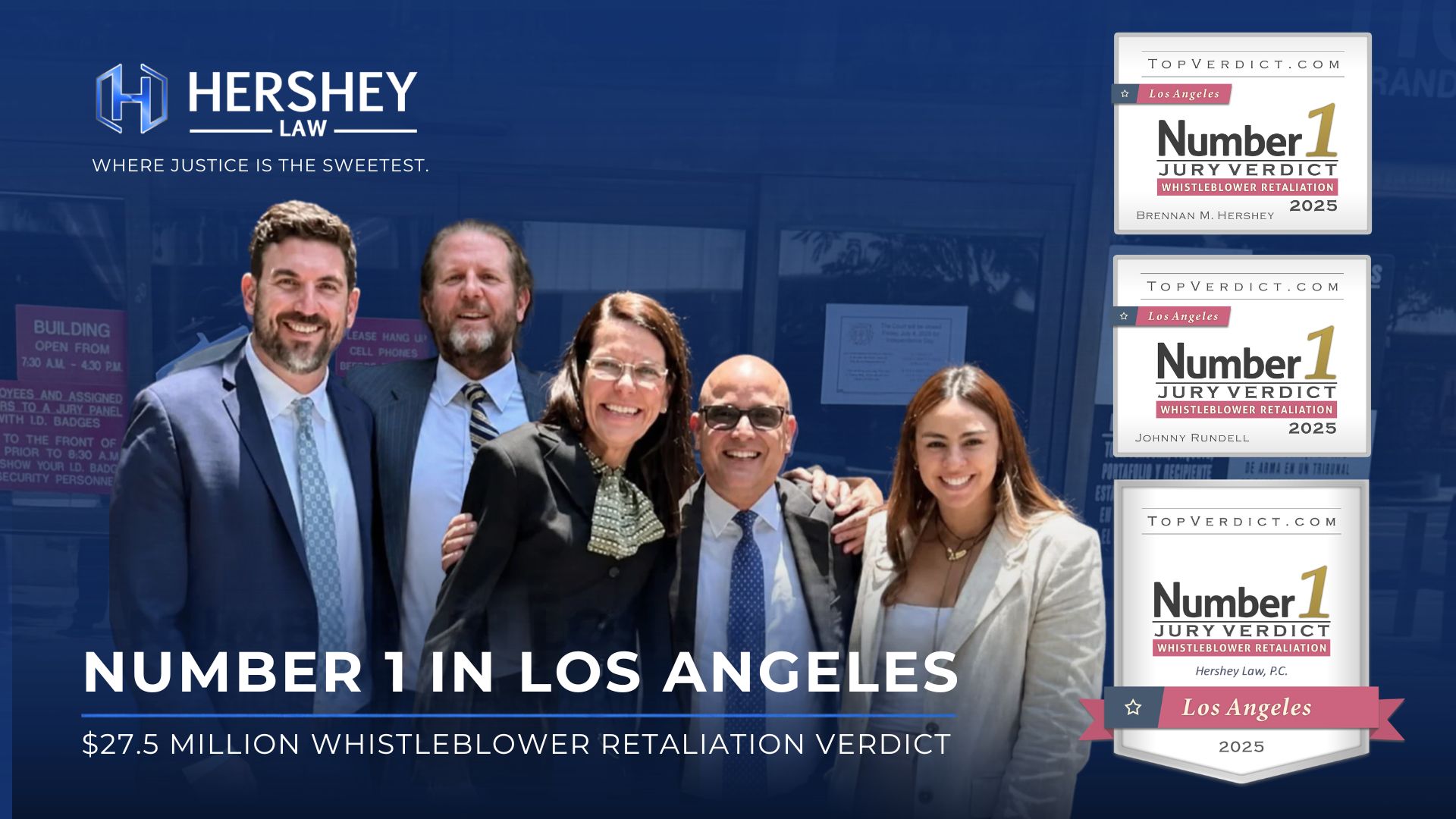
- $27.5 million jury verdict in a whistleblower retaliation case
- Super Lawyers Rising Stars recognition for our attorneys
- Exclusively employee-side representation — we never represent hospitals or employers
- Advanced legal technology used to analyze internal communications, incident reports, and personnel records
- Trial-ready attorneys who handle every case from consultation through resolution
Frequently Asked Questions
What Counts as Hospital Negligence a Healthcare Worker Can Report?
Hospital negligence includes any institutional failure to meet the accepted standard of care that places patients at risk — including inadequate staffing, wrong medication administration, delayed diagnosis, surgical errors, premature discharge, infection control failures, negligent hiring, and inadequate training. Healthcare employees who observe these conditions in good faith are protected when they report them to hospital administration or a relevant oversight body.
Can I Be Fired for Reporting Medical Negligence at My Hospital?
California law prohibits retaliation against healthcare employees who report medical malpractice concerns or unsafe hospital conditions in good faith. If adverse employment action follows a protected report, the employee may have a viable retaliation claim under Labor Code § 1102.5. Consulting an employment attorney promptly is critical because strict statute of limitations deadlines apply.
What Is the Difference Between an Individual Medical Error and Hospital Negligence?
Individual medical errors can happen even in well-run institutions. Hospital negligence refers to institutional failures — policies, staffing decisions, training gaps, or management choices — that fall below the accepted standard of care and create the conditions in which errors become likely or inevitable. Healthcare employees observing systemic medical negligence are reporting something more significant than a single incident, and the hospital can be held liable for that systemic conduct.
How Long Do I Have to File a Retaliation Claim After Reporting Hospital Negligence?
The statute of limitations varies by applicable statute. FEHA retaliation claims must generally be filed with the California Civil Rights Department within three years. Labor Code claims have different deadlines, and some are shorter. The statute of limitations begins running from the date of the retaliatory act, not the date of the original report. Consulting an employment attorney at our law offices promptly after experiencing retaliation is critical to preserving your options.
Does Hershey Law Handle Medical Malpractice Claims on Behalf of Patients?
No. Hershey Law represents healthcare employees who face retaliation after reporting hospital negligence conditions or unsafe practices — not patients pursuing medical malpractice claims against healthcare providers. If you are a healthcare worker who was punished for speaking up about patient safety, that is where we can help.
Recent Posts