Ethical and legal implications are two of the most important concepts in professional decision-making and they are frequently misunderstood as the same thing. Legal implications involve enforceable consequences under the rules of the legal system. Ethical implications involve moral responsibility, professional conduct, and judgment that goes beyond what the law explicitly requires.
Although the two often overlap, they are not identical. An action can be entirely legal under current rules while still raising serious ethical concerns. Conversely, some conduct that violates ethical standards may not yet be addressed by a specific statute. Understanding the distinction between legal implications and ethical implications helps businesses, professionals, and employees navigate complex decisions, avoid legal risks, and build long-term credibility.
This article explains what legal implications mean, how they differ from ethical considerations, how the legal system creates and enforces legal standards, and how these concepts play out in employment, healthcare, business, and professional practice.
What Are Legal Implications
Legal implications are the legally enforceable consequences that follow when a person, business, or organization violates a rule, statute, regulation, or contractual obligation recognized by the legal system. When legal implications arise, the government, a regulatory body, or an injured party can pursue formal legal actions including lawsuits, penalties, or criminal charges through the legal system.
Legal implications are defined by written rules created by legislatures, courts, and regulatory agencies. These rules establish what conduct is permitted, what is prohibited, and what consequences follow when the rules are not followed. The legal system provides the structure within which legal implications are identified, contested, and resolved.
Understanding legal implications matters for everyone — employees, businesses, professionals, and private individuals — because consequences under the legal system can affect income, employment, professional licenses, company structure, and personal freedom. Lawyers advise clients on the legal implications of their decisions before those decisions are made, which is why early legal consultation can prevent far costlier consequences later.
What Are Ethical Implications
Ethical implications involve the moral and professional consequences of decisions and conduct. Where legal implications are tied to rules that the government can enforce, ethical implications are grounded in moral principles, professional obligations, and shared standards of conduct that exist independent of any written statute.
A decision can carry significant ethical implications without violating any current rule in the legal system. Withholding material information from an employee about the terms of their severance agreement, misclassifying workers as independent contractors to avoid paying overtime while knowing the classification does not hold up under California rules, or creating a paper trail of performance write-ups to justify a termination that was actually motivated by retaliation — all of these may fall into gray areas of current legal rules while carrying serious ethical implications for the employer involved.
Ethical considerations also evolve faster than legal rules. In areas like artificial intelligence, data privacy, and workplace culture, ethical questions are frequently debated and resolved before formal legal standards are established. Businesses and professionals who pay attention to ethical implications rather than only minimum legal compliance are better positioned to avoid the legal implications that often follow when ethical failures become public.
The Key Differences Between Legal and Ethical Implications
The most important differences between legal implications and ethical implications lie in their source, how they are enforced, and what consequences they produce.
| Aspect | Legal Implications | Ethical Implications |
| Defined by | Statutes, regulations, and court decisions | Moral principles and professional codes |
| Enforced by | Courts, regulators, and government agencies | Professional bodies, employers, and public opinion |
| Consequences | Lawsuits, penalties, criminal charges | Reputational harm, professional discipline |
| Flexibility | Changes through formal legislative process | Evolves with social values and professional norms |
| Obligation | Mandatory compliance required | Voluntary, though breach affects trust and standing |
Both legal implications and ethical implications affect how businesses operate, how professionals conduct themselves, and how employees are treated in the workplace. Organizations that address both — rather than only the minimum legal requirements — are more likely to attract clients, retain employees, and avoid the legal risks that follow when ethical failures escalate into legal violations.
Legal Frameworks That Define Legal Implications
The legal system is not a single body of rules. Legal implications can arise under multiple overlapping legal frameworks, each of which governs a different category of conduct and produces different types of consequences.
Civil Law and Legal Implications
Civil law governs disputes between private parties — individuals, businesses, and organizations — where one party claims that the other’s conduct caused harm. Civil law legal implications typically result in lawsuits, damages, and court-ordered remedies rather than criminal punishment. Employment discrimination, breach of contract, and wrongful termination claims are all examples of civil law legal implications that employees and businesses commonly encounter.
In California, civil law legal implications under the Fair Employment and Housing Act are among the most significant that employers face. Businesses that violate FEHA’s rules prohibiting discrimination and harassment can face substantial civil liability, back pay awards, and attorney fee obligations.
Criminal Law and Legal Implications
Criminal law governs conduct so harmful to society that the government itself prosecutes the offender. Criminal law legal implications include criminal charges, criminal penalties, and in serious cases imprisonment. For most employment disputes, legal implications arise under civil law rather than criminal law — but certain workplace conduct, such as wage theft at scale or intentional fraud against employees, can carry criminal law legal implications alongside civil ones.
Understanding the boundary between civil and criminal legal implications matters when lawyers advise clients on the full range of consequences their conduct may produce in the legal system.
Tort Law
Tort law is a branch of civil law that covers legal implications arising from wrongful acts that cause harm to others outside of a contractual relationship. Tort law legal implications include claims for negligence, intentional harm, and strict liability. In employment contexts, tort law legal implications can arise from harassment that creates emotional distress, defamation of an employee, or intentional interference with an employment relationship.
Contract Law and Legal Implications
Contract law governs legally binding agreements between parties. Legal implications under contract law arise when one party fails to perform their obligations, called a breach of contract. In employment, contract law legal implications arise from violations of employment contracts, severance agreements, non-compete provisions, confidentiality obligations, and collective bargaining agreements. Businesses that impose non-disclosure agreements on employees in ways that violate California rules face legal implications under both contract law and California’s whistleblower protection statutes.
Administrative Law
Administrative law governs the rules, regulations, and decisions of government agencies. Administrative law legal implications arise when businesses or individuals fail to comply with agency regulations, licensing requirements, or reporting obligations. In the employment context, administrative law legal implications arise when employers violate rules enforced by the California Labor Commissioner, the Equal Employment Opportunity Commission, or the California Civil Rights Department.
Constitutional Law
Constitutional law establishes the foundational rules of the legal system and limits what government actors can do. Constitutional law legal implications most commonly arise in public sector employment, where government employers are bound by constitutional protections that private employers are not. Free speech protections, due process rights, and equal protection guarantees create constitutional law legal implications when government agencies retaliate against employees for protected activity or fail to provide fair procedures before adverse employment actions.
Statutory Law
Statutory law refers to written rules enacted by legislatures. Most employment legal implications arise under statutory law — the California Labor Code, the Fair Employment and Housing Act, the California Family Rights Act, and federal statutes like Title VII of the Civil Rights Act all establish specific rules that govern employer conduct and create legal implications when those rules are violated.
Legal Implications in the Workplace
The workplace is one of the most significant contexts in which legal implications arise for both employees and businesses. California’s legal system provides extensive rules protecting employees from unlawful conduct, and the legal implications for businesses that violate those rules can be severe.
Legal Implications of Workplace Discrimination
Employment discrimination occurs when an employer treats an employee unfairly based on a protected characteristic — race, gender, age, national origin, religion, disability, sexual orientation, pregnancy, or another category protected under California law. The legal implications of workplace discrimination include civil lawsuits under FEHA, awards of back pay and lost benefits, compensation for emotional distress, and attorney fees. Businesses found to have engaged in discriminatory practices also face reputational legal implications that can affect their ability to attract clients and hire employees.
Discrimination legal implications extend beyond the individual act of discrimination itself. When businesses fail to investigate discrimination complaints, fail to train supervisors on anti-discrimination rules, or allow discriminatory practices to continue after they are reported, the legal implications of that inaction can be as serious as the underlying discrimination. A lawyer advising a client facing discrimination charges can identify legal implications at every stage from the initial discriminatory act through the employer’s response and any subsequent retaliation.
Legal Implications of Sexual Harassment and Workplace Harassment
Sexual harassment and other forms of workplace harassment carry significant legal implications under both California and federal law. Legal implications arise when harassment is severe or pervasive enough to create a hostile work environment, or when an employment decision — a promotion, demotion, or termination — is conditioned on submission to harassment. Businesses face legal implications not only for the conduct of supervisors but also for harassment between employees when the business knew or should have known about the conduct and failed to take corrective action.
The legal implications of sexual harassment claims in California include civil liability, mandatory training obligations, potential regulatory investigations, and in some cases structural changes to company practices. Ethical implications follow as well where businesses whose culture tolerates harassment face long-term professional consequences even when specific incidents do not generate formal legal claims.
Legal Implications of Wrongful Termination
Wrongful termination carries substantial legal implications for businesses in California. While California follows at-will employment rules, those rules have significant exceptions. Businesses cannot terminate employees for discriminatory reasons, in retaliation for protected activity, in violation of public policy, or in breach of an express or implied employment contract. Each of these exceptions creates distinct legal implications for businesses that cross the line.
Legal implications of wrongful termination claims include reinstatement, recovery of lost wages, compensation for emotional distress, punitive damages in cases of egregious conduct, and attorney fees. A lawyer evaluating the legal implications of a termination decision considers the timing of the termination, the stated reason, internal communications, and whether the company structure and decision-making process followed the business’s own policies.
For employees, the legal implications of wrongful termination are equally significant. Understanding when a termination violates California rules — and knowing how to preserve evidence and meet filing deadlines — determines whether the legal implications can be pursued effectively in the legal system.
Legal Implications of Workplace Retaliation
Retaliation occurs when a business takes adverse action against an employee for engaging in protected activity like filing a discrimination complaint, reporting a safety concern, refusing to participate in unlawful conduct, or cooperating with a government agency investigation. The legal implications of retaliation in the workplace are among the most serious that businesses face under California employment law.
California’s Labor Code § 1102.5 establishes civil penalties of up to $10,000 per employee per violation for businesses found to have retaliated against protected employees. Additional legal implications include compensatory damages, emotional distress awards, and the reinstatement obligations that arise when wrongful termination follows protected activity. Under California’s SB 497, businesses that take adverse action within 90 days of an employee’s protected activity face a legal presumption of retaliation — shifting the burden of proof and magnifying the legal implications of poorly timed personnel decisions.
Lawyers who advise businesses on employment practices help identify the legal implications of proposed personnel decisions before they are implemented. Lawyers who represent employees in retaliation cases pursue the legal implications of those decisions through administrative and civil proceedings.
Legal Implications of Wage and Hour Violations
Wage and hour violations carry significant legal implications for businesses under California law. California’s wage rules require accurate overtime calculation, proper meal and rest break practices, compliant minimum wage payments, and accurate pay statements. When businesses fail to comply with these rules, the legal implications include recovery of unpaid wages, civil penalties, and interest often across entire classes of affected employees.
California’s Private Attorneys General Act (PAGA) creates additional legal implications by allowing employees to sue on behalf of themselves and other employees for wage and hour violations, with civil penalties flowing both to the state and to the affected workers. Businesses facing PAGA claims experience legal implications that can run into millions of dollars across large workforces where systematic wage and hour violations have occurred.
The legal implications of misclassification — treating employees as independent contractors when California rules require employee status — compound wage and hour legal implications further. Businesses that misclassify workers deny them overtime, benefits, and other protections, and the legal implications of that conduct include back payment of all withheld wages, penalties, and potential tax liability.

Legal Implications for Businesses and Company Structure
Every business faces legal implications tied to its company structure, its employment practices, and its professional conduct toward employees, clients, and the public. Understanding how legal implications arise from company structure helps businesses build compliance programs that protect both the organization and the people it employs.
Company structure determines which legal rules apply and what legal implications follow from violations. A sole proprietorship faces personal legal implications for its owner. A corporation has a distinct legal existence that creates different legal implications for shareholders, directors, and officers. Limited liability structures protect owners from certain legal implications but do not eliminate legal liability for the business itself when it violates employment rules, tort law standards, or contract obligations.
Businesses must also account for legal implications arising from their professional conduct in hiring, promotion, and termination decisions. A company structure that lacks clear documentation practices, consistent performance evaluation systems, or written anti-discrimination policies creates legal implications when personnel decisions are later challenged. Businesses that invest in professional conduct training, clear rules for supervisors, and written policies reduce their exposure to legal implications across every category of employment law.
Legal implications for businesses also arise from how they handle contracts with clients, how they manage intellectual property, and how they protect confidential information. Written contracts that clearly define obligations reduce legal implications from disputes. Clear intellectual property ownership rules protect businesses from legal implications arising when employees create work product during their employment. Businesses that fail to establish written policies governing these areas expose themselves to legal implications that a lawyer could have identified and prevented.
Legal Implications in Healthcare and HIPAA
Healthcare is among the most heavily regulated industries in the legal system, and the legal implications of non-compliance are significant for both healthcare organizations and the employees who work within them.
The Health Insurance Portability and Accountability Act — commonly called HIPAA — establishes federal rules governing the protection of patient health information. Health insurance portability under HIPAA creates legal implications for healthcare businesses that fail to protect patient data, disclose information without proper authorization, or neglect to maintain required security practices. Health insurance portability violations can result in civil penalties, regulatory investigations, and in serious cases criminal consequences.
For healthcare employees, the legal implications of HIPAA are equally relevant. Healthcare workers who improperly access or disclose patient information face personal legal implications including loss of professional licensure. Healthcare employees who report HIPAA violations, or who report other safety and compliance concerns within their institutions, are protected from retaliation under California whistleblower protection rules, and the legal implications of employer retaliation against those employees can include significant civil liability.
Health insurance portability rules also affect how healthcare businesses structure their operations, how they train employees on compliance obligations, and how they investigate and respond to potential violations. Businesses in the healthcare sector that treat health insurance portability compliance as a genuine professional obligation rather than a minimal legal requirement avoid the legal implications that arise when violations reach regulators or courts.
Intellectual Property Legal Implications in the Workplace
Intellectual property rules create significant legal implications for businesses and employees. Intellectual property includes creative works, inventions, trade secrets, trademarks, and other products of human creativity and innovation. The legal implications of intellectual property disputes in the workplace arise when ownership of work product created by employees is unclear, when employees take trade secrets to a new employer, or when businesses fail to properly protect their intellectual property rights.
California has specific rules governing intellectual property ownership in the employment context. California Labor Code § 2870 limits the extent to which businesses can claim ownership of intellectual property created by employees on their own time without using company resources. Businesses that attempt to claim intellectual property beyond what California rules permit face legal implications when employees challenge those claims.
Non-compete agreements — common tools businesses use to protect intellectual property and client relationships — are largely unenforceable in California. Businesses that attempt to enforce overly broad non-compete provisions against former employees face legal implications under California’s rules protecting employee mobility. A lawyer advising businesses on intellectual property protection in California can help identify which protective measures are legally permissible and which create legal implications rather than protection.
For employees, intellectual property legal implications arise when they leave an employer and face allegations of taking trade secrets or confidential information. Understanding the rules governing intellectual property ownership and proper use of confidential information prevents employees from creating unintended legal implications that can follow them to a new position.
Professional Conduct and Ethical Obligations
Professional conduct standards create ethical obligations that overlap with (and sometimes exceed) the minimum requirements of legal rules. In every licensed profession, professional conduct is governed by codes that impose ethical obligations beyond what the law strictly requires.
Lawyers are subject to the California Rules of Professional Conduct, which establish ethical obligations around client confidentiality, conflicts of interest, candor to the court, and professional conduct toward opposing parties. Violations of these professional conduct rules can result in State Bar discipline, suspension of the license to practice law, or disbarment — legal implications that a lawyer faces independent of any civil or criminal liability.
Ethical obligations in professional conduct also apply to medical professionals, accountants, engineers, and other licensed practitioners. Professional misconduct can produce legal implications through licensing board proceedings, civil malpractice lawsuits, and in some cases criminal charges. Continuing education requirements exist in most licensed professions precisely to ensure that professionals remain current on legal standards and ethical obligations as rules evolve.
In the employment context, professional conduct obligations affect how supervisors treat employees, how businesses handle complaints of harassment or discrimination, and how organizations investigate and respond to reports of misconduct. A supervisor who learns of harassment within their team and takes no action, or who discourages the reporting employee from pursuing the complaint formally, is engaging in professional misconduct that carries both ethical implications and potential legal implications for the business as a whole. Businesses that foster a culture of professional conduct — where ethical standards are actively reinforced and violations are addressed through consistent, documented processes — reduce their exposure to legal implications while building the trust that employees and regulators rely on.
Ethical obligations also arise in the context of informed consent within the employment relationship. Employers have an ethical obligation to ensure that employees understand what they are agreeing to in severance agreements, non-disclosure arrangements, and releases of legal claims. California law requires that employees be given adequate time and information to evaluate these agreements — but even when the technical legal requirements are met, presenting a severance agreement to an employee on their last day of employment without opportunity for legal review raises ethical implications about whether meaningful consent was actually obtained. When consent is obtained through pressure, incomplete information, or deliberately confusing language, the legal implications of that conduct can include unenforceability of the agreement itself.
When Legal and Ethical Implications Overlap
Many of the most significant professional and business challenges involve situations where legal implications and ethical implications converge. Understanding how the two interact helps businesses and employees make better decisions.
An employer who retaliates against an employee through a series of small, documented adverse actions — rather than an outright termination — may believe each individual action falls below the threshold of legal liability. But the pattern as a whole carries both ethical implications and cumulative legal implications when a court evaluates the totality of the employer’s conduct. Similarly, an employer who technically complies with California’s meal break rules on paper while scheduling employees in ways that make taking those breaks practically impossible may satisfy the literal text of the statute while violating both the ethical principles underlying it and, in many cases, its legal requirements when courts examine actual practice rather than written policy.
Whistleblowing is one of the clearest examples of legal and ethical implications converging in the workplace. An employee who reports fraud, safety violations, or regulatory non-compliance is fulfilling both an ethical obligation to protect the public and a legally protected right under California whistleblower statutes. The legal implications of whistleblowing include protection from retaliation — and when businesses retaliate against whistleblowers, the legal implications of that conduct are significant. Understanding the difference between whistleblowing and retaliation, and the legal implications of each, is essential for both employees deciding whether to report and businesses evaluating how to respond.
Why Understanding Legal and Ethical Implications Matters
Recognizing the legal implications of a decision before acting prevents regulatory penalties, lawsuits, and the professional consequences that follow when violations are discovered. Understanding ethical implications helps businesses and professionals avoid reputational harm and the long-term professional consequences that outlast any specific legal proceeding.
Organizations sometimes face public criticism for conduct that was not clearly illegal but appeared ethically indefensible. A business that implements a reduction in force targeting employees who recently filed discrimination complaints, frames performance improvement plans as documentation for a termination that was already decided, or pressures employees to sign broad releases without adequate time or information to evaluate them may not face immediate legal consequences — but the ethical implications of that conduct often precede formal legal proceedings when patterns become visible to regulators or juries.
For employees, understanding the legal implications of workplace conduct — discrimination, harassment, retaliation, wage violations — provides the foundation for protecting legal rights effectively. Employees who recognize the legal implications of what is happening to them can preserve evidence, meet filing deadlines, and engage a lawyer at the stage when intervention is most effective.
For businesses, understanding the legal implications of employment decisions, professional conduct standards, and company structure choices enables proactive compliance. Businesses that address legal implications early — through written policies, consistent practices, supervisor training, and regular legal review — avoid the far larger legal implications that arise when violations are discovered in litigation.
Legal Implications in the Context of Hershey Law
At Hershey Law, we represent California employees navigating the legal implications of workplace conduct that violates their rights. Every practice area we handle involves legal implications that affect real people’s careers, income, and professional reputations.
When an employee experiences discrimination, the legal implications of the employer’s conduct can include civil liability, back pay, emotional distress compensation, and attorney fees. When an employee is wrongfully terminated or faces retaliation for reporting misconduct, the legal implications of that conduct give rise to claims under California’s strongest employment protection statutes. When wage and hour rules are violated, the legal implications of those violations can be pursued through the Labor Commissioner or civil court.
Understanding the legal implications of what has happened to you is the first step toward deciding whether and how to act. Our lawyers advise clients on the legal implications of their situations honestly including when a claim is strong, when evidence may be insufficient, and when timing affects what legal implications can realistically be pursued.
Justice is the sweetest revenge. When employers violate employees’ rights, California’s legal system provides the tools to pursue the legal implications of that conduct. Hershey Law is prepared to help clients do exactly that. Schedule your free consultation today.
Why Choose Hershey Law
- Millions recovered for California employees in wrongful termination, discrimination, retaliation, and wage disputes
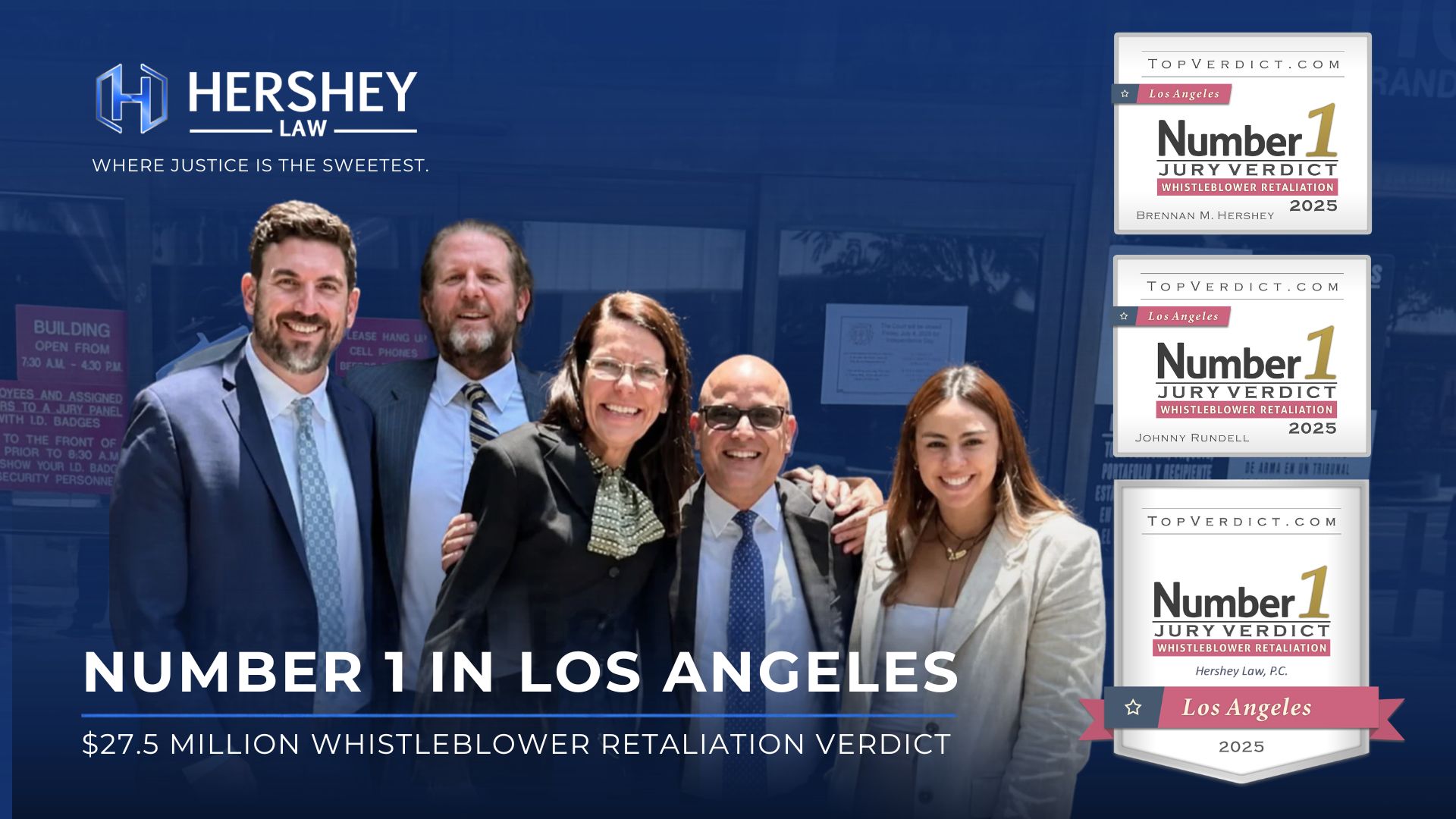
- $27.5 million jury verdict in a whistleblower retaliation case
- Super Lawyers Rising Stars recognition for our attorneys
- Exclusively employee-side representation — we never represent businesses, employers, or corporations
- Advanced legal technology used to analyze documentation, internal communications, and company structure records
- Trial-ready lawyers who handle every case from initial consultation through resolution
Frequently Asked Questions
What Are Legal Implications
Legal implications are the enforceable consequences that arise when a person, business, or organization violates a rule, statute, regulation, or contractual obligation within the legal system. Legal implications can result in lawsuits, civil penalties, criminal charges, regulatory sanctions, or court-ordered remedies depending on the nature of the violation and the applicable legal framework.
What Is the Difference Between Legal and Ethical Implications
Legal implications arise from violations of formal rules that the government or injured parties can enforce through the legal system. Ethical implications arise from violations of moral principles and professional conduct standards that may not be formally enforceable but that affect professional reputation, client trust, and long-term standing. An action can be legal yet carry significant ethical implications, and ethical failures often lead to legal implications when they escalate.
Can Something Be Legal but Ethically Wrong
Yes. An action may comply with current legal rules while still violating ethical standards of fairness, honesty, or professional conduct. Many legal reforms throughout history began as ethical debates before becoming formal legal requirements. Businesses and professionals who pay attention only to minimum legal compliance often find that ethical failures create legal implications as laws catch up to evolving standards.
What Are the Legal Implications of Workplace Discrimination
Workplace discrimination carries legal implications under California’s Fair Employment and Housing Act and federal civil rights laws. Legal implications include civil lawsuits for back pay, lost benefits, emotional distress damages, and attorney fees. Businesses found to have engaged in discriminatory practices also face regulatory legal implications and reputational consequences that extend beyond any single case.
What Legal Implications Arise From Whistleblowing
California employees who report unlawful conduct, safety violations, or regulatory breaches in good faith are protected from retaliation under Labor Code § 1102.5 and other statutes. The legal implications of employer retaliation against whistleblowers include civil penalties, compensatory damages, and reinstatement obligations. Understanding the legal implications of whistleblowing — both the protections available and the risks involved — is an important part of deciding how and when to report misconduct.
When Should You Consult a Lawyer About Legal Implications
As early as possible. Lawyers advise clients on the legal implications of decisions before those decisions are made, which is the most effective point for legal intervention. For employees, consulting a lawyer when workplace conduct begins to feel wrong — before formal adverse action occurs — allows the lawyer to advise on evidence preservation, filing deadlines, and strategic options that may no longer be available once the situation has escalated.